Did you know that many NIH scientists promoting mRNA receive a royalty kickback from the pharmaceutical industry? In law, we call this a conflict of interest. To this day, Doctor Anthony Fauci refuses to tell the American people how much he received in royalty payments to push two years of economic lockdowns on them. Although he claims to donate them to charity, almost every celebrity donates to their charities.
So why all the hush-hush? Sadly, investigative journalism appears to be dead. Only so-called “conspiracy theorists” seem to be covering the truth about the multiple convicted criminal felon pharma company Pfizer and others. Did you also know that several directors of the CDC are aligned with Bill Gates and other population control advocates? Did you know that many CDC and FDA heads worked for or got cushy jobs with BIG PHARMA after leaving their government positions? Do you think this is a problem?
I am attorney Michael Ehline. I am not “anti-vax.” MRNA does not inoculate as the Polio Vaccine did. The government changed the legal definition of vaccine once this fact came to light, and the lapdog press said it’s expected to change the definition. My mother-in-law died of Thrombosis (a known side effect of the emergency use “vaccines”) after being injected with the Moderna “vaccine.”
For-profit media and Silicon Valley receive billions in advertising money from Pfizer and other billion-dollar medical corporations; the current US Administration (FDA, CDC pharma Axis) appears to be a revolving door for Big Pharma heads. Our personal injury attorneys have done extensive research to present both sides of the mRNA story.
A recent investigation into the mRNA vaccine quality issues revealed that Pfizer’s COVID-19 vaccine contains Truncated mRNA, and their negligence could have far more significant repercussions than we are led to believe. Let’s explore the details of the investigation with Ehline Law and our personal injury attorneys.
What Is Truncated mRNA?
Between the genetic code in our DNA, which consists of nucleotides, and the protein it produces, which consists of amino acids, there is a bridge molecule referred to as the translator or the “messenger” ribonucleic acid (mRNA).
mRNA is a single-stranded RNA produced from the DNA template during transcription. A truncated mRNA occurs when there is a partial degradation of full-length mRNAs or when there is a premature termination of transcription, a process of copying a segment of DNA into RNA. However, many scientists also say this is dishonest. They claim this is “modified” RNA.
What Impact Does the Truncated mRNA in Pfizer’s Covid-19 Vaccines Have on Humans?
The Pfizer mRNA sequence is 4,284 nucleotides in length and consists of a 5′ CAP structure. To understand how the truncated mRNA can impact a human, we must first understand the basics of genetic code, such as a codon and open reading frame.
A codon is a sequence of three nucleotides that form a unit of genetic code in DNA or RNA. An open reading frame is a DNA sequence between the start and stop codons, with the stop codon at the end of a translatable region.
Just like brakes are essential to a vehicle to prevent accidents, the stop codon works similarly. When there are premature stop codons in an mRNA, the protein of interest is incomplete and, therefore, not produced, leading to a truncated mRNA.
However, if the truncated mRNA does not have a stop codon, it can be lethal to humans as the DNA may start producing highly toxic proteins.
Investigations Reveal Truncated mRNA in Pfizer Covid-19 Vaccine.
The European Medicines Agency (EMA) evaluates and supervises pharmaceutical products in Europe. In its report titled “EMA/CHMP/448917/2021,” the agency requested Pfizer address specific issues about its COVID-19 vaccine, including the impurities in the product described as “truncated and modified mRNA.”
According to the assessment report, Pfizer had a deadline of July 2021 to meet, address the concerns raised by EMA, and provide the agency with monthly data on the potential of autoimmune conditions arising from truncated spike protein.
It is important to note that the EMA did not simply raise the concern, but in the report, it marked the Truncated mRNA as a primary objection, a formal regulatory red flag. These biological agents deployed by the pharmaceutical company targeted the entire globe without explaining the truncated mRNA.
By June 2022, a leaked photo of a meeting between the Pfizer officials and the EMA discussing the primary concern surfaced on Trial Site News. According to the EMA, the truncated mRNA needed to be sufficiently characterized, described, and investigated to determine whether it was the same across all batches of the mRNA vaccines.
Pfizer Acknowledges Truncated mRNA and Responds to EMA in an Official Meeting.
As evident from the leaked presentation slide, during the meeting, Pfizer and its officials acknowledged truncated mRNA in their mRNA vaccines. The officials responded that most of the truncated mRNA in Pfizer’s mRNA vaccines are 1,500 to 3,500 nucleotides long, consisting of a 5′ CAP structure without a Poly(A) tail and the stop codon.
Since DNA does not have a stop codon, there is no stop signal, meaning that the amino acid chain continues prolonging, which prolongs the mRNA spike protein. In the DNA sequence, if the spike protein takes over, it will lead to further spike proteins with multiple repeats since there is no stop codon. During this process, a different mRNA can take over; if that happens, the DNA sequence will create unknown proteins.
What’s fishy about all this is that when you download the EMA report titled “Type II group of the variations assessment report,” it is completely blacked out on page 17, table 2 Poly(A) content.
Researchers use the “western blot” method, an analytical technique for detecting specific proteins in a tissue homogenate or extract sample. This technique can help researchers analyze the size and count of the protein.
The EMA requested that Pfizer-BioNTech submit experimental findings of their mRNA vaccines to show that they would not lead to fragmented protein. The EMA’s requirement is a basic requirement that pharmaceutical vaccine manufacturers must address before humans can use the vaccines.
However, since this is the first time mRNA vaccines have been used across a large population, the quality issue is the first of its kind. There is uncertainty over any previous quality standard to help manage truncated mRNA.
To fulfill the bare minimum requirements of EMA, in December 2020, Pfizer provided them with digitized western blot figures that showed the levels of spike protein in their Covid-19 COVID-19 vaccines and suggested that no other proteins were produced. In a report published by the FDA, Pfizer stated that their COVID-19 vaccine protein is consistent with the expected size and comparable across all batches.
In 2021, Pfizer provided another digitized western blot figure showing that its COVID-19 vaccine did not produce proteins in vitro.
However, all the western plots provided are entirely digitized, raising further concerns about the results of their experimental findings.
Did Pfizer Provide Fake Western Blots?
Pfizer submitted many sets of western blots that could be fake. The proteins are different sizes and separate at various locations. Certain factors affect the appearance of western blots, including protein transfer speed, incubation duration, and antibody concentration. All of these suggest that Western blots cannot be perfect, and there will always be distortions.
Many of the Western blots provided by Pfizer seem too perfect. They appear spotlessly clean and perfectly rectangular. All the Western blots are noiseless and appear to be fake.
Why Did the EMA Approve the Pfizer Covid-19 Vaccines Despite Dangerous Components?
According to the EMA, further categorization is needed, but the lack of experimental data on truncated mRNA should not lead to any conclusions.
At the end of the report, the EMA states that there are no longer any issues with the Pfizer COVID-19 vaccines, and by December 12, 2020, the EMA gave Pfizer marketing authorization.
Several questions arise from the EMA’s conclusion over Pfizer Covid-19 vaccines. How did Pfizer resolve the issues raised by the EMA? Did the pharmaceutical company provide them with fake Western blots and receive an approval nod? Did the counterfeit reports manage to get the support of the regulatory body? Does the EMA know the reports are fake, yet have they given the vaccine manufacturer the approval nod? How did this get under the FDA’s Radar, or do they not care?
Are All Covid-19 Approved Vaccines mRNA?
Although researchers have studied mRNA for decades, during the pandemic, it was the first time they used it to create a vaccine. Pfizer and Moderna vaccines are mRNA vaccines, while others use different technologies. Novavax created its vaccine using a process similar to developing a flu vaccine.
The US Food and Drug Administration has approved the use of the only mRNA vaccines, Pfizer and Moderna vaccines, in the United States.
Pfizer Covid-19 Vaccine Ingredients
The following is the breakdown of the ingredients used in the Pfizer Covid-19 vaccine:
Messenger ribonucleic acid (mRNA) instructs the body to create a form of protein from the COVID-19 virus. Although the Johnson vaccine is not mRNA, it also instructs the body to form protein from the COVID-19 virus by entering human cells using the DNA stored inside a modified vector virus.
Lipids are a broad group of organic compounds that are fatty acids. The following are some of the lipids used to create Pfizer Covid-19 vaccines: 2[(polyethylene glycol (PEG))-2000]-N, N-di tetradecyl acetamide
Salt: Sodium chloride, a form of salt, and other salts are essential to the human body as it helps maintain fluid levels. It also aids inthe stability of the Covid-19 vaccine. The following are the different types of salt used in the Pfizer Covid-19 vaccines: Potassium chloride
Monobasic potassium phosphate
Sodium chloride
Dibasic sodium phosphate dihydrate
Other ingredients, including sugar, help maintain the vaccine’s stability and keep the molecule in shape.
Other brand vaccines also use citric acid monohydrate (Johnson & Johnson), acetic acid (Moderna vaccines), and ethanol.
Pfizer’s COVID-19 Vaccine Triggers a Severe Allergic Reaction
According to the Centers for Disease Control and Prevention, 20 cases of severe allergic reactions were recovered or discharged home. Many scientists believe that the compound polyethylene glycol in the messenger RNA is causing a rare form of allergic reaction in some people who have taken the Pfizer vaccine.
Although polyethylene glycol (PEG) is a component in some drugs, it was never used to create a vaccine. The compound has occasionally resulted in anaphylaxis, an allergic reaction of the immune system, the body’s natural defense system, overreacting to a trigger. Scientists believe that people with high levels of PEG have an increased risk of anaphylactic reaction to the Pfizer Covid-19 vaccine.
Could Pfizer End up in Trouble with Their Covid-19 Vaccines?
Vaccine manufacturers have immunity against legal actions for any injuries caused by their vaccine. It is important to note that pandemics like COVID-19 arrive unexpectedly, and vaccine manufacturers do not have much time to experiment and carry out human trials, so they receive immunity against legal action if their vaccines cause injuries.
However, immunity does not extend to vaccine manufacturers’ negligence. If Pfizer knows its COVID-19 vaccines are impure and intentionally provides fake reports to receive market authorization, it could be in hot water.
Further investigation can help reveal the depth of the situation and the damage the pharmaceutical company has done with their truncated mRNA COVID-19 vaccines on a global scale. The problem is that Pfizer seems to be controlling the messaging with billions of dollars in ad money. Why would a journalist who wants to keep their job report anything negative, even if it’s true?
Our Marxist-run colleges can’t handle the truth and constantly say Hitler was right-wing. Let’s explore the reality instead of their propaganda. Before Der Führer’s rise to power in creating a totalitarian state similar to Stalin’s, there was a time in Adolf Hitler’s life when his views contradicted the ideologies professors say he later embraced (identical to communism).
“Iamasocialist,” “We are socialists” – Adolph Hitler
Educated historians KNOW that he was a communist during World War I, siding with the Bavarian Soviet regime, while others (mainly Marxist academics) describe him as an opportunist searching for his true calling. Here, we will simplify the explanations from both sides to reveal the untold story of his early ideology. I have included this well-researched video to dispel your brainwashing.
From Chaos to Control: The Führer’s Uncertain Path to a Totalitarian Nazi Germany State
Before joining the National Socialist Party in 1919, Hitler’s political run didn’t seem to have a direction, say the leftists. It was confusing and disorienting at best. In the book Hitler’s First War by Thomas Weber (a leftist “historian”), the author explains how the leader’s socialist agenda differed significantly from the realities on the ground (but his book is full of contradictions and half-truths, basically pro-Marxist propaganda).
Weber correctly states that if Hitler were hyper-nationalist or anti-Semite and cooperated with the regime to steer young Germans away from communism, he would’ve joined the many right-wing youths and done what they were doing in the country or become part of the Freikorps, secret paramilitary volunteer units.
Like his colleagues, Hitler could’ve resigned from his post then, but he didn’t. Nor did he do anything to overthrow the Weimar Republic regime in 1919. What many people fail to understand is that if Hitler was hiding his true colors, why didn’t the other men in his unit make statements about it later on? You won’t find the Führer bragging about this in his book Mein Kampf.
They claim young Hitler was likely confused at the time. He hadn’t learned about anti-Semitism and how it could be used as a political tool to gain leverage over others and steer the destiny of Germany on a path of his choosing. But in reality, he blamed Jews for ruining his communist party, as will be discussed.
After serving 2,050 days in the German Army, Hitler was formally discharged on March 13, 1920. Marxist professors claim this “freedom” gave him enough time to focus on the Nazi Party and political thinking (national socialism), creating policies that would arise from his contradictory impulses.
Hitler Was a Communist in 1919? Here Are the Facts!
In 1917, a German politician, Kurt Eisner, a Jew, joined the Social Democratic Party of Germany when the First World War peaked before being convicted of treason in 1918. After spending nine months in Stadelheim Prison, he was released in October that same year, starting a series of events that would topple the monarchy in Bavaria.
Eisner wanted independence and attempted to reform the capitalist system into a social one. He created the Bavarian Soviet Republic (BSR) during the German Revolution and led the state until his assassination in February 1919.
During this time, Hitler was elected as “Deputy Battalion Representative” and was voted by his fellow soldiers, meaning he best represented their COMMUNIST views.
However, the Bavarian socialist regime quickly became unpopular among the German people, as it had failed to maintain food supplies, provide jobs, or keep the transportation system functioning. Slowly, voices against Eisner emerged, mocking the German politician and his policies.
As hatred for the Bavarian leader spread across the country, Anton Graf Arco-Valley, an officer close to conservative right-wing circles, assassinated Kurt Eisner in 1919, right when he was on his way to resign. He had a huge funeral, and among the thousands of attendants, one that stood out the most was Adolf Hitler.
Surviving footage of the event shows Hitler marching in the funeral procession with a black and red armband, the former to symbolize mourning and the latter representing his support for the socialist revolution in Munich.
Now, the shocking fact revolving around this story is that Kurt Eisner was Jewish. It’s challenging to ascertain whether Hitler was truly supporting the Soviet Republic or whether he was taking an opportunity not to return to his impoverished civilian life before the war. In other words, Hitler was not anti-Jewish. He only became anti-Jewish when he concluded the Jewish leadership of the German communist party was ineffective in trying to make Germany a satellite of Russian Communism. Hence, as discussed, Hitler later wanted German national communism.
What’s even more interesting is that in Hitler’s biography, Mein Kampf mentions that a few days after the liberation of Munich, he was requested to appear before the Inquiry Commission, which started his political movements.
However, this was a lie, as he had been involved with the Bavarian COMMUNISTS and was a political representative, meaning he was already in politics. Instead of leaving Munich, Hitler took part in the so-called Jewish revolution, supporting Eisner even until the very end. College professors hate this truth.
Hitler Becomes a Member of the Communist Party in the Soviet Republic
After Eisner’s fall, Max Levien, a German-Russian communist politician and co-founder of the Communist Party of Germany, attempted to establish a Soviet-style system in Bavaria. Under his leadership, a new government elected Hitler as the representative for his battalion, making him a member of the Communist Soviet government with ties to Moscow.
“Iamasocialist,” “We are socialists.” – Adolph Hitler
During this brief period, Hitler not only supported the communist regime but also pledged his loyalty to a government that had allegiance with Lenin’s Soviet Russia. Like the Bavarian Soviet Republic, this government was also unpopular, as the communists decided not to help people experiencing poverty despite their ideology.
When food shortages heightened, people started to voice their concerns, demanding that the Soviets feed them. Sadly, the government’s response wasn’t what they expected.
“What does it matter? … Most of it goes to the children of the bourgeoisie anyway. We are not interested in keeping them alive. No harm if they die – they’d only grow into enemies of the proletariat.” – A BSR Government Representative
On April 27, 1919, Leviné’s committee resigned and reelected the Toller government to take charge of the Bavarian Soviet Republic. At the same time, the rival government, Hoffmann’s People’s State of Bavaria (seated in Bamberg), marched with 8,000 troops to take control of the region.
The two governments fought, but the 30,000 soldiers of the BSR army were too much for Hoffman and his supporters. He quickly made a deal with Lt. General Burghard von Oven, who lent him 20,000 Freikorps members, sealing the city’s fate. BSR fell, as more than 600 people lost their lives, and Leviné was arrested and shot by a firing squad.
Many historians continue to state that Hitler wasn’t a communist. Let’s consider that assumption for a bit. After reading all of the information about his political involvement in BSR, if Hitler was counterrevolutionary and hated the Jews, how come he was friendly with his colleagues, who were mostly Jews?
Even Weber doesn’t provide examples of antisocialist expressions that Hitler supposedly said, so we can’t be sure whether they were antisocialists or just the usual disputes within the socialist camp.
Hitler Turns to a Strong Resolve to Create a Nationalist (Communist) Government
After the regime ended in BSR, the newly elected government recruited Hitler for a post in the military administration’s information office. He would spy on people and political gatherings to identify those who threatened Bavarian authorities.
Hitler excelled in his training and soon became an instructor for the Reichswehr (German Armed Forces). He stood out as an effective communicator. The Military’s commander, Captain Karl Mayr, impressed with Hitler, asked him to elaborate on his views on Jews.
We know how hand-in-hand the soon-to-become Nazi leader was with the Jews in 1919. This time, his response was quite the opposite. He characterized them as a disease that needs to be removed from Germany.
On September 12, 1919, Hitler denounced a speech favoring Bavarian separatism. A few months later, he joined Deutsche Arbeiterpartei (DAP), which later changed to the National Socialist German Workers’ Party (NSDAP).
Once officially discharged from the German Army in 1920, he quickly rose through the ranks of the German Workers’ Party. By 1921, he became an absolute Führer (leader) of the NSDAP, further excelling his political movements. This eventually led to the Beer Hall Putsch and his arrest before he soon became a chancellor, assuming the powers of the presidency and leading the German nation on a newly set course against the Jews.
Historians argue that Hitler was an opportunist, which led others to believe he was a communist due to his unwavering support for the BSR regime in 1919. However, he could have easily revolted like the Freikorps and right-wing youth. Perhaps he was confused before branding himself as a German nationalist after Leviné’s fall.
Hitler Wasn’t a Communist. Another Interesting Interpretation of the Facts!
Far-left fact-checkers like Snopes use opinion-based “fact checks” to “prove” Hitler was not a communist. Some videos on the internet provide “facts” about how Hitler associated himself with the German communists. However, these portray the postwar period as incredibly simplistic when the reality Germans and Hitler faced was far more complex.
When Hitler’s colleagues chose him as a Deputy Battalion Representative in the elections, it is possible that he would’ve spoken in favor of the views of the socialist governments among his ranks. This would’ve garnered support from other soldiers.
Weber’s (a hard-core academic Marxist) book paints a poor picture, trying to convince readers that Hitler was an opportunist and not a communist by interpreting fragments of information or evidence. At best, according to Weber, he may have flirted with various left-wing politics and political parties in Bavaria but was far from an active participant.
Historians like Ian Kershaw and Volker Ulrich argue that Hitler may have formed his Weltanschauung when he was young, and the war acted as a catalyst for his preexisting ideas of nationalism, anti-Semitism, militarism, and hatred of Russian or Jewish socialists.
Adolf Hitler never kept a diary or recorded his internal thoughts. The sliver of evidence is skinny, meaning it can be used to tell either side of the story.
Hitler and the Emergence of Anti-Semite Views
Hitler hated “Jewish communism” and was not the father of anti-Semitism. We wanted his own version of German communism. Although he may have hated the Jews later after his bad experience with Marxists, this type of discrimination and prejudice existed long before he began his political movements.
During the nineteenth century, Jews faced persecution across much of Europe for religious reasons. However, religion played a minimal role in shaping public perspectives in Germany. Politicians would use the “race” card to rally the people and achieve their agendas.
The German people were against the Jews not because they were not Christian but because the Jews were of a different “bloodline.” To the locals, they were an unacceptable race that had infiltrated the country.
In his book Mein Kampf, Hitler writes that he became an anti-Semite due to the long personal struggle he experienced throughout his life. Perhaps his aversion to everything Jewish gradually began during his time as a painter in Vienna (1908-1913). This seems highly unlikely, as Samuel Morgenstern, a Jew, was his most loyal buyer.
Historians provide differing explanations for the reasons behind Hitler’s anti-Semitism. Some say he hated the Jews due to trauma from a poison gas attack during World War I, while others argue that he contracted a venereal disease from a Jewish prostitute. There is no evidence to support either of these claims.
That said, it seems more plausible that Hitler was deeply dissatisfied with losing the war. Some historians believe he blamed the Jews, social democrats, and communists for betraying the German people, which he felt ultimately led to their defeat. This could explain the emergence of his anti-Semitic political views after 1919.
I am Michael Ehline, an expert on the Common Law History of Becoming a Lawyer without law School and formation of bar exams. Securing your Juris Doctorate (JD) or law degree from an ABA or state-accredited law school is a prerequisite before practicing law in most U.S. states. The UK, including its commonwealth, has a similar path. Although I studied law under the California State Bar Law Office Study Program guidelines, only a handful of U.S. states have their versions of legal apprenticeships.
Some people think there are advantages to attending a traditional, costly law school if they can survive during legal studies and its enormous, crushing student debt. No matter what, either way, there is no such thing as a quick law degree. No matter what, a minimum level of training will be needed.
Below, I will discuss American common law history, the myths associated with Moorish sovereigns, and sovcits about the B.A.R.
ANCIENT TO MODERN TIMELINE OF BECOMING A LAWYER WITHOUT LAW SCHOOL
Law schools were not even a thought. Clergy was the closest thing England had to lawyers by the time of Alfred the Great. Lay people or “commoners” were generally not law practitioners. Hence, there was no “common law” yet. Commoners descended from Germanic barbarians and often resorted to trial by battle, self-help, and blood feuds to resolve legal disputes.
There was no such animal as a wrongful death lawsuit, for example. Ultimately, these heathen leaders received education from church institutions, including law and history. Eventually, commoners practiced law using rules modified from former Canon law religious courts and the shire’s royal laws.
527-565 – The Roman Emperor Justinian prohibited any clergyman from pleading in lay courts, whatever the nature of the cause unless it was one in which he had a personal interest or his Church or monastery parish was involved. Despite this, western bishops turned a blind eye, their clerics influencing and even running royal, secular courts for hundreds of years. Besides, clergy were typically the only people who could read, write, or conduct record-keeping for local public officials. The king’s scribes were often religious monks, for example.
557 A.D. – Middle Ages Ecclesiastical Legal Advocacy
In Western Europe, the Justinian interdict was largely ignored (See above). Because of his education, the clergyman became indispensable in all matters concerning the orderly transaction of public business, whether in the chanceries or the courts.
First Lawyers Had No Law School?
True, no law schools existed until well after the Church created our modern university system. Few people other than clergy educated in guilds or schools practiced law. Hence, educated lawyers monopolized legal jobs, as they do today. Due to the Papal Bulls against owning a Bible, let alone reading, the church controlled thought, similar to how modern [politicized] social media has taken over modern “news” reporting/censoring.
People who were called cleric lawyers:
Proctors: If a party to action appeared by a proctor, the proctor represented the party.
Advocatus: But if the party had the assistance of an advocate, the party had to make a personal appearance in court, supported, aided, counseled, and advised by the advocate on all matters of law and procedure.
Hence, the ecclesiastical proctor remained similar to early mediaeval attornatus’ (see below), whereas advocates had similarities to a mediaeval pleader, forespeka, vorsprecher narrator. However, advocates could argue and not just repeat statements.
Mediaeval Proctor
The ecclesiastical proctor was a kind of “officer” appointed by the court or selected by the client to represent a party that empowered him to appear on its behalf and manage its cause. Under certain conditions, the same person could act both as a proctor and advocate in the same case for the same client.
Medieval Advocate
Contrary To English Shire Courts, Parties In Religious Courts Were Allowed Their Advocates Any party appearing in an ecclesiastical court, whether as plaintiff or defendant, could appear either in person or by counsel, professional or not. In some instances, the court might insist on the appearance of counsel for the party. The professional duties of an ecclesiastical advocate loosely resembled the Roman Imperial period advocate.
In mediaeval society, clergymen were practically the only people who possessed some of that general education and learning, which is necessary to present or plead a case intelligently and convincingly. But subsequently, a difference arose as to the propriety of clerics practicing law, the custom varying depending upon who was in charge.
Did Proctors Or Advocates Attend Law School?
No. There were no law schools. And they probably had no undergrad requirements. We do know when proctors were commissioned candidates, and they had to pass through an apprenticeship.
Moral Character Rules – Genesis
Our secular moral character requirements are inherited from sixth-century ethics rules and standards. A cursory inspection of the Corpus Juris Civils of Justinian, especially of the Codex, shows the massive extent to which lawyers’ ecclesiastical regulations were dependent on Roman law. (Cf. Chroust. The Legal Profession in Ancient Imperial Rome, 30 NOTRE DAME LAW. 521, 579 (1955)).
Several provisions and rules existed regarding the supervision and discipline of proctors. They were to display restrained and dignified conduct in the presence of the court, refraining from “loud speech and babbling, and behave themselves quietly and modestly.” (Could not buy the litigation, acquire an interest in the case, demand an excessive fee, or betray their client’s confidence to their party in opposite).
1230: One title is based on the Decretals of Pope Gregory IX, published around 1230, which includes Pope Gregory the Great of 596’s regulation, one from Pope Alexander III (1159-1181), one by Pope Clement III (1187-1191), four by Pope Innocent III (1198-1216), and two of Pope Honorius I (1216-1227). Six more were issued by Pope Gregory IX (1227-1241).
Circa 1298: Pope Boniface VIII’s Sixth Book of the Decretals followed Roman law, modified or expanded by Papal Decretals (decrees), Church Councils, or bishop/court created local statutes.
Compare Early Germanic Secular Courts – Rarely Recognized Another’s Right To Advocate
In a nutshell, Germanic peoples and their early Anglo-Saxon ancestors had no use for what we now call lawyers. These were warrior societies. “…every man ought to fight his own battles, using his hands or tongue as the occasion required.” (Id at 539). They looked down upon accusers refusing to litigate, arbitrate and face death for making accusations during their parliamentary courts, called the “Thing” or “Althing.”
During the arbitration, the accused and accuser might engage in trial by battle, the surviving victor being innocent of all charges. It appears that ancient courts relied upon a lawman to recite the law.
But this person did not advocate and was typically someone belonging to the king’s court. Modern scholars believe many German tribes were outlaws who either fled Scandinavia or were banished. (Source) (See also). The 5th and 6th Century German invasions of Western Europe saw the end of the once highly developed, prosperous Roman legal profession. (See Chroust, The Legal Profession in Ancient Imperial Rome, 30 NOTRE DAME LAW. 521 (1955); Chroust, The Legal Profession in Ancient Republican Rome, 30 NOTRE DAME LAW. 97 (1954); Chroust, Legal Education in Ancient Rome, 7 J. LEGAL ED. 509 (1955)).
These tribes, including the earlier-ancient Romans before them, had no attorney-client advocacy system, mainly because no concept of legal “agency” existed. (acting on another’s behalf in law.
Early Orators In Legal Causes Were The Closest Thing We Had To Secular Lawyers?
The Rise of The Vorsprecher
Germanic tribes allowed an accused, their professional orator, or Vorsprecher, to speak “their words” during court.(Vorsprecher, forespreca, furisprecho, redesman rechtsprecher, spruchman, rechtsager, asega, eosago, sagibaro, talman, prolocutor, or plain “mouth-piece”). A Vorsprecher was not trained in the law, nor was he allowed to advocate. He was to appear [often as a professional orator] to narrate their version of the facts.
But some Germanic kings vested others acting in their own interests with the right of representation by an advocate. It seems German tribes insultingly called these legal pleaders “criers.” (Latin: Clamatores). But anyone could be your Vorsprecher, even the judge deciding the case against you. No legal training was required because no advocacy was allowed unless you were the king’s Vorsprecher. (Vorsprecher‘s were great orators and storytellers, often becoming great leaders).
Distinguish Vorsprecher With Scandinavian “Lagman”
At first, lawspeakers/lagmen represented the people, and their duties and authority were connected to the assemblies (things). For most of the last thousand years, however, they were part of the king’s administration. A lawspeaker or lawman (Swedish: Lagman, Old Swedish: laghmaþer or Laghman, Danish: lovsigemand, Norwegian: Lagman, Icelandic: lög(sögu)maður, Faroese: løgmaður, Finnish: laamanni, Greenlandic: inatsitinuk) is a unique Scandinavian legal office. It has its basis in a common Germanic oral tradition, where wise people were asked to recite the law. The lawman’s function evolved into a legal office.
Germanic Tribes Become Anglo-Saxons Settling Britania
During this period, around the 5th century, Voumllkerwanderung tribes, including those formerly residing in Germany’s Angles and Saxony, settled part of Brittain, ultimately becoming Anglo-Saxons. (But other tribes mixed, including Goths, Ostrogoths, Visigoths, Lombards, Suebi, Frisii, and Franks).
Lack of Stable Laws = Social Instability
However, Nordic people’s preferring poetry and oral histories over a more superior written system of stable laws with professional clerks, courts, and advocates weren’t progressing society forward. Ancient England was far from being a unified society under such an unstable, Spartan-like system.
“It is an old axiom that a true legal profession – a class of trained and professionally acting experts who are conscious of their expertness and, hence, of their peculiar status within a given society – cannot possibly be found until there exists something like a fairly distinct and stable body of laws, a somewhat settled jurisdiction with regular courts handled by experts, and a fairly consistent legal procedure.” (Anton-Hermann Chroust, Legal Profession during the Middle Ages: The Emergence of the English Lawyer Before 1400, 31 Notre Dame L. Rev. 537 (1956).)
Ultimately, as laymen were admitted to the bar, these “commoners” practiced what is modernly “common law.”
813 AD – Council of Mainz
Clerics and monastics were again prohibited from actively participating in a secular lawsuit, except when involving Church or a Church interest or defending orphans or widows.
871 AD – Enter Alfred The Great
Ultimately, especially after the accession of Alfred the Great (Viking slayer) (871), the realm developed established rules similar to traditions inherited from wandering Germanic tribes. The Doom Book, Dōmbōc, Code of Alfred, or Legal Code of Ælfred the Great was the code of laws (“dooms” were laws or judgments) compiled by Alfred the Great. Alfred codified three previous Saxon codes:
Alfred prefixed the Ten Commandments of Moses. He even incorporated Mosaic Code rules of life into a Christian code of ethics. The History Channel smash hit mini-series, Vikings loosely bases some true history about Alfred’s desire to learn history and benevolence during Ragnar’s conquests. For example, some crimes were monetarily compensable concerning victim restitution. But there were still no lawyers, as we call them today.
1066 AD – Enter William the Norman Conquerer
After the successful King William’s 1066 Norman invasion of Britania, things dramatically changed for legal professionals. Our American common law system can be seen as a fusion between:
Laypersons entering legal practice/advocacy after the 13th century.
William, I brought efficient legal administration at speeds only dreamed of by King Alfred. He was heavily reliant upon court clerks and chroniclers, establishing the first English Census. We must remember that the Normans were French-speaking descendants of Danish-Norwegian Vikings, raiding and settling France’s western coast. These barbarians ultimately absorbed Christianity, with its more refined Holy Roman clerical and legal systems.
Fusion of Anglo-Saxon-Norman-Papal-Law
But Norman custom was not simply transplanted into England; upon its arrival, an emerging new body of rules based on local conditions materialized. Elements of King Alfred’s burgeoning Anglo-Saxon system surviving the “Invasion” included the jury, ordeals (trials by testing physical strength or by “battle”), and outlawry (banishing a person beyond the protection of the law or exiling them).
Commoners were not allowed to practice law, as they were not clergy. The king’s roving secular courts had not yet conflicted as they would in later papal power struggles.
Normans maintained the use of writs (orders mandating someone to appear at a court; see also,The development of a centralized judiciary). We must always remember that priestly study was among the highest status education one could receive. Only men of God could read, and the church prohibited the private ownership of Bibles. Ecclesiastical law and papal canons needed interpreting.
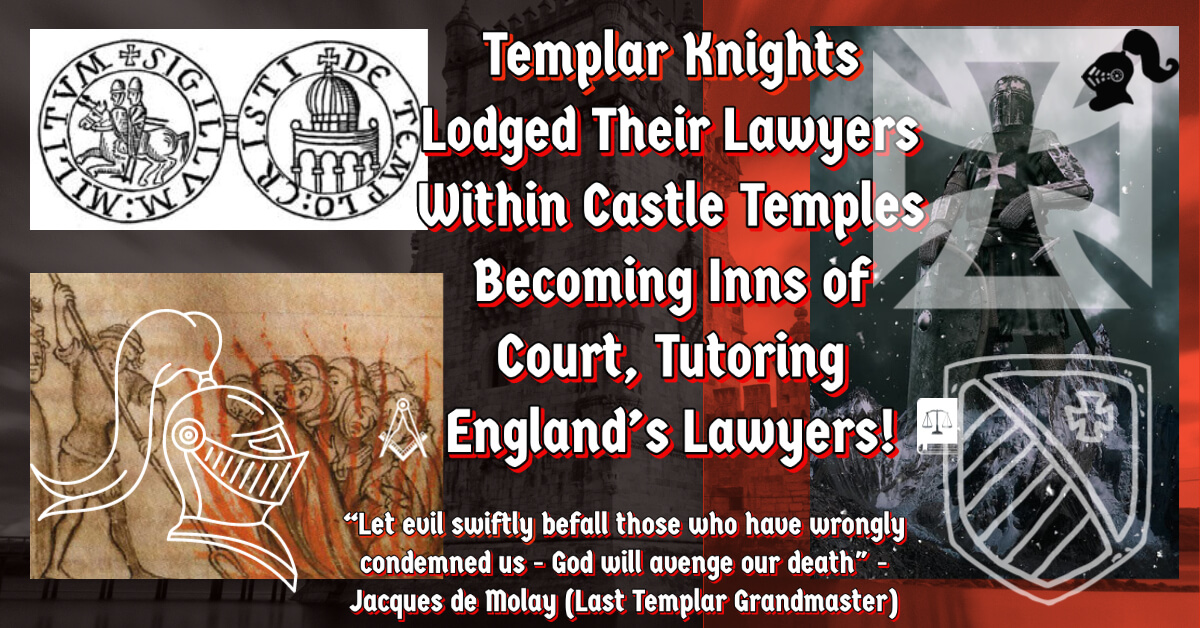
Even the Holy Templar Knights (Knights with banks, lands, titles, and money needing management and legal protection) maintained their own priestly house counsel, as it were.
No English Common Law Existed?
True. England had no professional, commoner lawyers or judges; instead, literate clergymen administered, some familiar with Roman law and the canon law. During this period, the Christian church developed the universities of the 12th century. Before the Reformation, mediaeval Roman Canon law had original jurisdiction over most English legal matters.
Civil Canon law was basically copied from Rome’s Civil law, influencing modem English ecclesiastical and common law. America’s first corporate universities, including Harvard, adopted this religious heritage, emblazoning its first two official seals with “Christo et Ecclesiae” (“For Christ and Church”) (1650 and 1692).
Canon Law Applied
Canon law was applied to English church courts, with revived Roman law seeing less influence in England, despite Norman’s government dominance. England and its colonies during the 12th-13th centuries saw ecclesiastical law taught mostly by the clergy. Even the king’s early central courts had no professional advocates. The proceedings were informal, and parties (or their speakers) presented their own cases before their king, noble, or clergy.
Until the thirteenth century, and far into it, the clergy remained the prominent legal practitioners in the ecclesiastical courts and lay courts. As a matter of fact, clergymen predominated lay courts so much that a word was coined: Nullus clericus nisi causidicus (no clergyman was not also a legal practitioner). It would not be till much later that British Canonical law was subsumed into the Chancery court.
The First English Law Clerk Was A King?
Probably. Norman princes were educated in all manner, including by professorial monks. The Anglo-Saxon Born Norman king, Henry I, was called Beauclerk because he was well educated, fluent in Latin reading and writing, with knowledge of Anglo-Saxon Domesday Book laws, nature, and history. Beauclerk was a fan of the last Anglo-Saxon King, Edward the Confessor. (1042-1066).
Edward’s mother, a Norman, and was born around 1003, or 1005. Edward was recorded as a “witness” overseeing the two charters of 1005. In the early 1030s, Edward witnessed four charters in Normandy, later signing two of them as king of England.
1100: (The Charter of Liberties, also called the Coronation Charter, was Henry I’s written proclamation to bind the King to certain laws regarding the treatment of nobles, church officials, and individuals. (Magna Carta forerunner).
1140 – James Brundage has explained: “[by 1140], no one in Western Europe was a professional lawyer or canonist.”
Henry II (1154–1189); Rise Of The “Common” “Law Attornatus” and Servientes or Serjeants
Henry II’s royal officials roamed the country, inquiring about administering justice. Church and state were separate during his reign, each having its own law and court systems. This led to centuries of rivalry over jurisdiction, especially since church courts’ pre-Reformation appeals could be taken to Rome. And all the “lawyers” of the day were religious employees.
Attornatus Defined
The term attornatus, or attorney, probably is early German. (Anglo-Saxon) Freemen of each shire were regularly summoned to the Torn by the shire reeve (modernly, sheriff). Any man incapable of personally attending the torn could send their friend or close family member relative to represent the missing person “at the torn.”
Their “attorney” substitute now represented the attorney party. Other theories exist the word is French atournee or atourner, with Godofredus labeling this an 11th Century Latinized “loan word.” Gradually this became a person prepared or equipped to act in substitution of parties during legal proceedings.
Attornatus Distinguished From Forespeka
The attornatus, forensically speaking, remains clearly distinguishable from the forespeka or Vorsprecher. “If you appear by attorney, he represents you, but when you have the assistance of an advocate [scil., a leader], you are present, and he supports your cause by his learning, ingenuity, and zeal. Appearance by attorney is one thing, but admitting advocates to plead the cause of another is a totally different proceeding.” (Serjeant’s Case 5; Lord Brougham explains attorney-pleader (forespeka) differences.).
1150 – A small but increasing number of the clergy became experts in canon law. But the clergy gradually withdrew or became barred from practicing law in lay courts. Laypeople had begun replacing clergy legal practitioners.
1161-1185: The First Temple, or Inns of Court
No one knows the Inns of Court’s exact origins. But believe it or not, the Knights Templar liked lawyers. Originally, their lawyers lived with them in their castles. Ultimately they became Inns, where all lawyers in England received legal apprenticeships. But, they were central to the development of English law and the Legal Profession. By 1422, the king’s serjeants were almost exclusively drawn from the court’s four inns. Mentors gave readings on commoner lay laws and certain aspects of Roman law. (Fun fact: Ancient Serjeant = Modern Sergeant = Servant)
Almost all the Judges taught there and returned to attend readings. And the inns weren’t aloof as to the developments of the common law. But their primary function was to “preserve and elaborate the settled learning concerning real actions and real property, and it was in that sense that the law schools made tough law.” The Inns showed us the law was not a creature of statute only. They showed us a human influencers’ body, refining the legal profession, producing future legislators and judges.
The Honourable Societies – The Inner and Outer Temples were sandwiched between the remnants of Roman ruins called “the Liberty of the City,” just outside London’s protective walls. “This gate opens not immediately into the City itself, but into the Liberty or Freedom thereof.” (Queen Anne, 1708).
The Templars considered it an honor to remain posted outside the “protective walls” of London’s secular society.
The Temple’s construction and remodel phases can be dated between 1161 and 1185, named for the warrior monks of the iconic Order of The Knight’s Templars. Templars originally lodged its lawyers and allies, the Knights Hospitalers, within Temple walls. The Temple is where knights launched holy crusades when England’s Kings and Rome’s Pope were were religious allies.
Rank Structure Of The Temple Inns
The masters became known as benchers while the students were classified into three categories:
Readers: Experienced teaching assistants/students, known as readers, were employed in instruction in somewhat the same manner as contemporary law school professors.
Inner Barrister: New students, whose course of instruction was largely lecture and observation were denominated inner barristers.
Outer Barrister: outer barristers, were perhaps the equivalent of today’s second-year law school class and their studies were dominated by participation in the “moot.”
Possible Origins Of the Legal Term “Bar”
Temple Bar. Evolved from the so-called “Liberty line,” or “First-Barrier” (A chain gate draped between the Temple and London’s gates.). Ultimately, the bar meant one thing for “legal London,” and another for the courts. (This is where we traced the legal terms “Barrister,” and “passing the bar,” or first barrier to practicing law) Modernly, each Temple’s dining hall still has a long wooden bar dividing the governors (benchers) from their apprentices. For non-lawyers, since 1351, the Temple Bar is mentioned historically as the location victorious kings would pass beneath its arches. This may have something to do with holy crusades being launched from this location.
“The Liberty line was marked by a chain gate which became known as the Temple Bar, now a stone gateway of the same name. Along with London Bridge, the gateway became a prime public location used to display the heads of traitors and rebels as a warning to others. Below the gateway was a well-used pillory.” – Duhaime’s Law Dictionary, “Inns of Court Definition.”
Call to the Bar or Call to Bar referenced the wooden barrier separating the public and “Apprentice at the Law” from the judge’s bench. Barristers, like attorneys today, stood or sat behind the bar while speaking to and facing the judge, staging their legal briefs, papers, and pleadings there. (We lawyers must seek admission from the court before passing the bar to approach the bench (See the Temple influence? Ex: “Your honor, may I approach?“)
Bar in the Middle Ages: The Bar also referenced the king’s summons, calling a legally qualified man to address the King’s Bench’s legal issues.
“Bar” Modern Use: Ultimately, in common law countries, this term interchangeably came to mean passing a bar exam and being admitted to practice law as a barrister or attorney, with solicitors passing a different but similar examination. Modernly, some scholars claim that the word bar was derived from the old English/European custom separating court business between a public viewing area. At least one Wikipedia editor thinks, “The origin of the term bar is from the barring furniture dividing a medieval European courtroom.”But they provided no citation in support.
See the Image of the Bar!
Myths and Fantasies – British Accreditation Registry “BAR”
No, there is no legitimate or recognized entity known as the “British Accreditation Registry” (often abbreviated as BAR). This term is sometimes associated with the “sovereign citizen” movement. Many of them claim the legal profession and court systems in English-speaking countries, particularly the United States, are secretly controlled by foreign powers, often referencing the British legal system.
The acronym “BAR” in legal contexts usually refers to the legal profession, such as being “admitted to the bar,” which means a lawyer is authorized to practice law after passing an exam and meeting other qualifications. But we have not had anything to do with a so-called “British Accreditation Registry.” In short, the “British Accreditation Registry” is not a recognized institution and we found zero evidence it has anything to do with various common law bars, or any bars for that matter.
England’s Four Inns of Court
Due to the different types of legal education required, four Inns of Court evolved to train Barristers, responsible for teaching and nurturing law students for their unique legal skills as follows:
Ultimately, this Temple Inn evolved into two “Temples,” as follows:
The Honourable Society of The Inner Temple,
The Honourable Society of The Middle Temple
Next on our list of Inns of Court are:
3. The Honourable Society of Lincoln’s Inn: not to be confused with Abraham Lincoln, remains the largest Inn, with official records showing its existence since at least 1422.
4. The Honourable Society of Gray’s Inn: traces its roots to 1569, but law student studies likely never happened there until the later fourteenth century.
Brief Legal Education History Of the Inns of Chancery
There were two types of Inns, Inns of Court and Inns of Chancery, attached to an Inn of Court “like Maids of Honour to a Princess.” These Inns were responsible for training solicitors. There were other equitable courts we will not cover here. This study limits itself to the evolution away from apprenticeships and the remnants left behind in those few hold-out states. At their height, there were eight or ten Inns of Chancery.
Inns Of Court Legal Education
Evolution Of Law Practice Admissions From Guilds to Inns
As the namesake suggests, inns were various structures housing various law students who would live and earn their keep as apprentices, laboring under their legal masters, reading for the law, and eventually working as barristers solicitors (previous Court of Chancery lawyers).
Inns remained unincorporated bodies, run by senior members called “masters of the bench” or “benchers.” When law students had been “called” to enter the profession by fellow Inn members, they would receive recognition and authorization to legally practice law and plead at the bar in England’s higher courts.
What Was The “Moot”
The best method of legal education for Inns members was attending court. When the court was in session, the Inns were crowded with the judges, lawyers, and students. When courts were not hearing cases, law readers gave lectures and conducted Bolts within the same courthouses, a special moot court.
Since case reports were rare, moots and open court helped students understand current legal questions, as they were argued by admitted and skilled litigators with student input. After moot courts, a collegial and pedagogical discussion between the above parties ensued . “the mooters presented the judges with a slice of bread and a mug of beer. . . .”
At night, generally, Inns students engaged in educational exercises.
End of the Moots
By the eighteenth century, the readings and moots had declined, students being left mainly to their own devices. England’s only requirement for bar admissions by benchers of the Inns was proof that they had kept twelve terms eating the mandatory number of meals.
Another method to gain bar entry was proof a student had clerked with established barristers. But barristers had no formal time commitment to supervise law students in the barrister’s chambers. With no standard tests, apprenticeship quality was never subject to objective, standardized evaluations.
Origins of the Crib and “Crib-Notes”?
Although student-barristers were expected to read certain standard works, such as Littleton, Coke, Glanville, and Bracton, Lord Mansfield set aside a portion received most barrister legal education in the courts. Lord Mansfield set aside a portion of the courtroom for student use to accommodate student needs, called the “crib.” Incidentally, the modern phrase “crib notes” likely arose from his teaching method.
The UK’s new legal system presented many opportunities for non-clergy and other men of the cloth to read for and practice law during the 14th century.
1164: During this period, we see Inns of Court coming into its own. Religious officials became absolutely disqualified by Papal Bull from law practice in lay courts.
1178: King Henry II appointed two clerics and three laymen to a “permanent and central court.” From this time on, it was not unusual that laymen on the Bench should preside over their ecclesiastical brethren.
1179: Third Lateran Council [Citation needed]
1190 to 1230: A crucial shift began with some men practicing canon law as legal professionals.
1215: Fourth Lateran Council admonishedclergyto never appear for a secular lawsuit, except in cases affecting themselves or on behalf of the poor and the distressed.
1215: Magna Charta agreed upon by king Henry II.
1216-1272 – Henry III: By now, despite the Papal admonishments, most royal justices, including royal clerks or officials, were technically clergymen. But beginning under Henry III would recruit his lawyers would recruit lawyers from the royal Bench’s Bar.
1217: Law of the Forest (introduced as policy in 1217 and confirmed by Edward III in 1225).
1217-1218: The Pope, frustrated with King Henry I and II, prohibited England’s clergy from practicing law in secular English Common Law courts. “neither clerics nor monastics are to appear as advocati in a secular court, unless in their own causes or in those of the poor.” (Later incorporated in the so-called Constitutions of Cardinal Otho in 1237).
1225: Law of Forest confirmed.
1232: Two French councils in 1231 had mandated that lawyers had to swear an oath of admission before practicing before the bishop’s courts in their regions. A London papal legate created a similar oath in 1237.
1234: Ultimately, in 1234 AD, Henry III banned legal education “within the City” of London, prompting a mass legal educator exodus, including clergy and law students leaving the protective “Liberty” of the City’s walls. (He couldn’t just ban priest law teachers, as he could set of a Holy War against England) The warrior Templar monks (See above), still vassals of the Pope, granted these legal disciples respite alongside their own legal counsel then training as Templar lawyers, renting space as it were, to these displaced jurists.
1236: The great barons of Normandy were permitted to appoint an attornatus, provided they ‘had secured a royal license…”
1237: Constitutions of Cardinal Otho affirms restrictions on religious officials participating in secular courts.
Clerical legal representatives were on the decline in England, as was Rome-based Christianity.
1270-1300 – Rise Of The Full Attornatus
By now, we see two classes of attorney rise:
Full Attornatus: The full attornatus helped courtiers, nobles, clergy, people living far away, or those engaged in protracted causes. Because certain people (sick, infirm, far away) could not always appear personally, the attornatus became a class of pros and, like servientes or serjeants, were becoming “full-time lawyers.” But unlike public deputies of the day, these new representatives were educated.
Attornatus Regis: The King’s attorney. (See below)
1272-1307 – Edward I: The English Bench and Bar’s secularization continued, ushering in a class of professional legal practitioners in general. By Edward’s death, most English lawyers practicing law in royal courts were professional laymen. Edward also instituted the first Moral Character Law.
1275: France’s professionalization trend saw a proposal at the Second Council of Lyon in 1275 that all ecclesiastical courts must institute an oath of admission influential in many European courts, including England.
1275 – First Statute of Westminster: England’s civil courts joined the trend towards professionalization. (Statute was enacted punishing professional lawyers guilty of deceit). (no sheriff shall suffer “barretors to maintain quarrels in their shires, neither stewards of great Lords, nor others, unless he be attorney for his Lord, to make suit or give judgment in the counties …” The non admitted attornatus was considered a deputy, not respected as the Crown’s particular attornatus, merely acting as their lord’s deputy at the Bar or Bench.
1278: The King’s attornatus or attornati, called attornatus Regis (King’s attorney), sued the Bishop of Exeter. After that, Attornatus Regis began assuming serviens Regis roles. But the King’s attorney still needed the “King’s commission.” (or Chancellor’s commission).
1280: the mayor’s court of the city of London promulgated regulations concerning admission procedures, including administering an oath.
1285: Second Statute of Westminster provided penalties for serjeants, leaders, and attorneys who engaged in unprofessional conduct. Lawyers were made legally liable for defrauding clients and negligent representation of causes. Lawyers were penalized if convicted of engaging in or consenting to deceit or collusion in Royal courts. But mainly it was the King’s serjeants, and pleaders complained of.
1288: Norman attornatio were finally allowed to practice in lower Norman courts.
1289: “The City Ordinance of 1289” regulated London’s legal practitioners.
1290: The so-called Mirror of Justices observed that “no counteur [pleader] should be a man of religion or an ordained cleric.”
1292: King Edward I appoints 140 attorneys, including their apprentices, to accompany his common-law courts, helping litigants. This increased formal legal training needs in the realm.
1294: The 1288 Norman Court rule allowing law attornatus in lawyer courts was abolished in 1294 by the Parliament of Paris, including Normandy.
1295: First Mention of Attorney General. “because John . . . is at the King’s command, . . . he may have general attorneys in all his lawsuits.” The King, London, and the great barons, like any large corporation, constantly needed competent legal representation.
1297: Confirmatio Cartarum – Edward II recognizes pre-existing natural laws respecting liberty and freedom from certain government interference. (Learn more about Natural Law Here).
1297: Remonstrances – Edward II is served with the Remonstrances. Edward I’s incessant wars and his confrontational style led to conflict with some lay and ecclesiastical lords. Edward II’s bias towards his lover/friend Piers Gaveston in giving him royal titles created great jealousy among the realm’s magnates as well, culminating in complaints about the royal government.
1298: London’s First City Attorney – London appoints William of Grantham (Granham or Graham) city attornatus to the royal court, “to receive annually so long as he be attorney twenty shillings.” (“the freedom of the City” granted to “attorney before the King.”)
Over time, the legal profession in England was divided into two functions; as follows:
Forespeaker (advocatus or prolocutor): A person stood beside a litigant and spoke as if they were him.
Attornotus or procurator: A representative who acted on behalf of someone in his absence, bound to represent that person.
1307-1327: Edward II complained his Barons of the Exchequer admitted attorneys in other courts. This period saw the extraordinary growth of a professional attorney class. The Crown regularly granted permission to appoint special and general attornati, either by statute or by writ. The attornati also received remuneration from clients.
1308: Parliament banishes Lord Gaveston, [previously banished by Edward I’s father] (Earl of Cornwall, and likely Edward II’s homosexual lover) from the realm under pain of Papal ex-communication.
1309: Edward II convinces the Pope to drop annulment risks against Gaveston, and Lord Gaveston returns to England from Ireland.
1309: Gaveston’s arrogance remains such an affront to the Lords, barons, bishops that many in parliament won’t attend sessions with Gaveston present. The king ordered Gaveston to stay away, and parliamentarians appeared, illegally, wearing full battle regalia, armed, demanding the appointment of Ordainers. Their goal was to prevent the king from acting against their interests again.
1311: Ordinances of 1311 are accepted by Edward II under duress, forced upon him by Papal clergy, including rebellious Baron’s and Lords, called Lord Ordainers. (Attempting to end arbitrary royal government action, including confiscatory taxes, etc.)
1312: Lord Gaveston is captured and executed when two Welshmen beheaded him on behalf of Parliamentarians and their allies, [now preparing for war against the Crown] his body left behind.
1312:The End Of Templar Influence Over English Legal Education. Most of us are aware of motion pictures like Tom Hank’s, based on Dan Brown’s best-selling book, Davinci Code. As in real life, the King of France, going bankrupt from Holy Crusade debts, conspired with the new Pope to destroy the Knights Templar. France’s king attempted to confiscate Templar’s wealth. The Church turned its allied Orders living in England against the Templars. The English King was also deeply in debt to the Templars. So he saw no problems when the Order of Saint John’s Knight’s Hospitalers defeated the Temple Inns Templar crusaders in 1312, displacing their former landlords. But their Order honored the rental/lease agreement of the resident lawyers and law students apprenticing there.
1322: The Statute of York, 1322 undoes the Ordinances of 1311 and prohibits lawmaking attornati and inferior officers of the royal courts (clerks) from interfering with royal prerogative.
1344: Inns of Chancery, Clifford’s Inn is said to come into existence.
1349: Marks the era England/Papacy began severing secular disputes from Papal courts and clerics in earnest.
1349: Thavie’s Inn of Chancery was founded, and for several centuries, Chancery Inn education was the first step towards equity practitioners becoming a barrister. A student would first join one of the Inns of Chancery, where he was taught moots and rote learning by Readers sent from the Inn of Court to which his Inn was attached. These readers presided over the moots and engage in class discussions. At the end of each Inn’s legal term, gifted students would be transferred to the parent Inn of Court for stage II.
1392: The House of Commons suggested that no clerk attached to Royal courts should be admitted as counsel or attornatus to other parties. (conflict of interest). (Attorneys are also no longer held liable for their client’s wrongful deeds).
1402: In the year 1402, the Commons complained that many instances of legal malpractice had occurred.
1413: Statute was enacted protecting law practitioners as a class, restricting legal practice. (No Under-Sheriff, Sheriffs Clerk, Sheriff’s Bailiff or Receiver, may act as an attorney in royal courts while holding office – Titles of Nobility).
1439: The attorney was fined forty shillings for failing to pay for his law license. (No person should regularly practice law unless duly admitted by the Mayor and Aldermen).
1461: Approximately 100 students engaged in Inns of Chancery studies. Inns of Chancery also served as accommodation and offices by solicitors.
1512-1517: Fifth Lateran Council.
1517: Luther nailed his 1517 smash hit Ninety-five Theses to the door of a local Dioces, with copies being made widely available. With the invention of the Guttenberg printing press, copies of the Holy Bible, banned from public view by the Church, would become widely available. No longer maintaining a biblical text stranglehold, the Catholic Church was confronted by renegade, heretic German monk Martin Luther.
1521: Edict of Worms officially bans Holy Roman Empire citizens from agreeing with or spreading Luther’s “blasphemy.”
1535: The Protestant Reformation became a huge powerplay for Europe’s monarchs and Hapsburg Empire loyalists. The political separation of the Church of England from Roman influence brought England alongside this new movement. Henry VIII establishes the Anglican Church, tired of the Pope’s spiritual control over English courts and people. The king effectively breaks England away from the Papacy after its final insult in refusing to annul his marriage to Catherine of Aragon.
1539: Ultimately, the British Crown evicted the Knights Hospitallers and Order of Saint John from this guilded property between 1539-1540.
1562: The Statute Against Forgery prohibits attorney punishment for pleading his client’s forged deed if he was not a party to the forgery. (“immunity” of attornatus is older).
1608: King James I enacts Inns of the Court Charter. (Law students, teachers/governors have rights to stay and train at Inns of Court).
Date: The English Reformation sped up under King Edward the VI. But then, for a short period, Queen Mary I and King Philip Catholicism were back. But The Act of Supremacy 1558 renewed the schism, with the Elizabethan Settlement earning Britain its sovereignty from Rome.
1620: Senior English judges ruled that all four inns would maintain equal order of precedence. The English legal craft of learning the law from the 16th century forward would primarily involve legal apprentices volunteering, or paying a fee, attending court with their masters, living and working among either their head barrister, “professors” until the cessation of apprenticeship training, swearing their lawyer’s oath.
1642: After the First English Civil War in 1642, teaching Chancery students to be barristers at the Inns ended. Chancery Inns were now a dedicated association for solicitors used as offices and accommodations. England’s war of independence hurt the legal profession. This is where we see barrister Inns of Court seven or more years of legal training all but disappearing as a rule.
The Decline of Inns Chancery-Importance In English Law Legal Studies
By the 15th century, these Inns of Chancery had already morphed into preparatory schools for the Inns of Court, after the Inns of Court began charging higher acceptance fees to students trained in independent Chancery Inns. Experienced solicitors made Inns sort of a warm marketing network, similar to CAALA or ABOTA today. Still, many Inns fell in and out of allegiance with the Inns of Court, with some claiming independence through the eighteenth century.
NOTE: American Inns, similar to English Inns, are akin to social clubs, offering mentoring and guidance rather than supervising law study. I, too, was a member of the Benjamin Arranda III pupilage group of Redondo Beach, California.
NOTE: Like today’s law schools, only very wealthy or well-off students could pay the exorbitant price of an Inns of Court legal education, with King James requiring “a gentleman by descent” as a pre-condition to entry.
1673: These Temple’s residents, by now mainly Middle and Inner Temple pupils and law mentors, ultimately purchased the defeated Templar’s land and structures in 1673 for a £78 payment.
1729: These legal training methods slowly fell into decline after the latter 16th century, with many students now reading books made possible in part by Luther’s popularization of the printing press. With Inns training being replaced by Blackstone and Sir Francis Bacon’s writings, the mid-17th century saw little formalized English legal education until the solicitor’s apprenticeship program in 1729.
1739 and 1825: The foundation of the Society of Gentlemen Practisers and Law Society of England and Wales in 1739 and 1825 were professional bodies established for professional solicitors but gradually dissolved and sold over time.
This section covered most of the ancient history of becoming a lawyer. Go here to read part two about becoming an attorney under common law.
It’s called the District of Columbia Act of 1871. But I digress. “Sovcit,” or “Sovereign Citizen,” means many things to American citizens, especially within the federal government.
The District of Columbia Organic Act of 1871, passed by Congress, repealed the individual charters of the cities of Washington and Georgetown. It established a new territorial government for the District of Columbia. While this territorial government was repealed by Congress in 1874, the legislation was significant as it marked the creation of a single municipal government for the Federal District.
The passage of the Residence Act in 1790 fostered a new federal district to serve as the capital of the United States. This District was formed from land donated by the states of Maryland and Virginia. Notably, the capital territory already included two sizable settlements: the port of Georgetown in Maryland and Alexandria in Virginia.
In 1791, a new capital city was founded east of Georgetown in honor of President George Washington. Shortly after, Congress passed the Organic Act of 1801, which organized the federal territory. The territory east of the Potomac River within the federal District formed the new county of Washington. This county was governed by a levy court consisting of seven to eleven justices of the peace appointed by the president. Additionally, it was governed by Maryland law as of 1801.
According to the Sovereign Citizen’s Handbook, The US went bankrupt under Roosevelt and was taken over by banks to bail us out. Sovereigns believe the Organic Act of 1871 set the stage.
“The UNITED STATES corporation now uses your birth certificate, filed as a registered security with the United States Department of Commerce, as collateral to secure credit from the World Bank, England’s private bank, thus making you liable for the national debt..” (International Bankers Guilty of Mass Bank Fraud.)
So-called “sovcits,” say before this, all Americans were “sovereign citizens.” Of course, there are many people with similar views who do not endorse the opinions of others. According to many legal experts, including me, it is a catch-all word used by the administrative state to define anyone who believes in limited government. Sovcits, like most intelligent people, don’t think the mainstream media, aka for-profit media. So, I am hoping you will appreciate this expert information from a legal history expert and civil rights lawyer.
When I use it here, I am using it as a catch-all, so please don’t hold it against me. Have you ever wondered what the Organic Act of 1871 entails and how it compares to modern sovereign citizen ideas? You’re not alone. Understanding historical law could sometimes seem akin to unwrapping a complex legal puzzle. So, let’s dive deep into the matter and shed light on this iconic legislation and its implications in today’s context.
“Law doesn’t exist merely to place regulations. It’s there to shape society and reflect its changing needs.”
Police and the Southern Poverty Law Center claim that the “sovereign citizen movement” believes individuals can choose whether or not to subject themselves to governmental laws created after 1871. This invites a vast array of legal issues and potential confabulations.
Exploring the Organic Act of 1871
Most of our founding fathers did not want a national debt.
When America canceled the Charter of the First National Bank in 1811, this precipitated an economic recession and the War of 1812. According to Sovcits, this was punishment for America refusing to do business according to the wishes of the International Banking House of Rothschild.
Congress refused to let the National Bank renew its Charter. It was followed by 4500 British troops burning down the “White House, both Houses of Congress, the War Office, the US State Department, and the Treasury and destroyed the ratification records (signed by 12 US states).”
Except for Gen. Andrew Jackson’s victory in the Battle of New Orleans, the War of 1812 ended in a string of American military disasters.
During the war and the post-war recession, the Republican government, under James Madison, re-established a second National Bank of the United States in 1816.
In January 9, 1832, President Andrew Jackson vetoed the Bank’s recharter on the grounds that the Bank was unconstitutional and won! Jackson then paid off the national debt, leaving the U.S. with a surplus of $5,000.
1868: Ultimately, the Fourteenth Amendment and Sixteenth Amendment were deemed legal. President Lincoln was assassinated before ending [unlawful] martial rule by executive order. (Sovereigns say the Republican’s veto-proof 14th Amendment created a “new citizenship” or “status” for expanded D.C. jurisdiction using UNELECTED carpetbaggers and blacks placed in Southern State assemblies by Republicans guilty of treason.)
Soon after, Congress allowed the privately run “Federal Reserve” into power. They began printing FIAT currency, and the republic is now over 75 trillion in debt, teetering on a mass financial depression. Anyone who disagrees with its legality is immediately branded as a nut, parroting “conspiracy theories.” Tens of thousands of Americans say it’s no conspiracy theory at all.
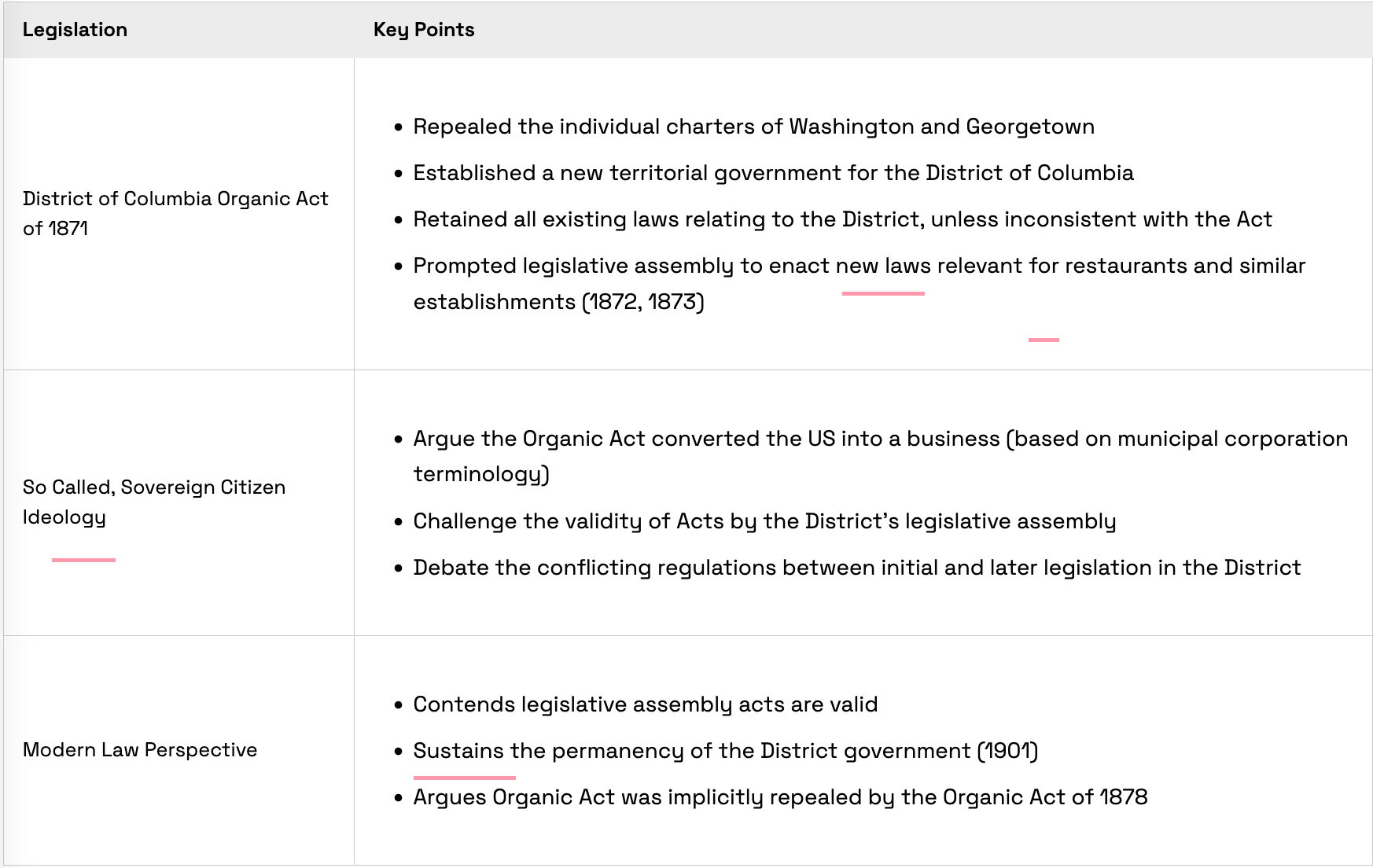
Legislation Key Points District of Columbia Organic Act of 1871
Repealed the individual charters of Washington and Georgetown
Established a new territorial government for the District of Columbia
Retained all existing laws relating to the District unless inconsistent with the Act
Prompted legislative assembly to enact new laws relevant to restaurants and similar establishments (1872, 1873.)
So Called Sovereign Citizens – Ideology
Basically, they argue the Organic Act converted the U.S. into a business (based on municipal corporation terminology)
Challenge the validity of Acts by the District’s legislative assembly
Debate the conflicting regulations between initial and later legislation in the District
Sovereign citizens assert that gold fringes on American flags in courtrooms are evidence of admiralty law in effect. This leads sovereign citizens to believe that U.S. judges and lawyers are agents of a foreign power. This foreign power is typically thought to be the United Kingdom. Another belief they carry is that the word “bar” is an acronym for “British Accreditation Registry.” This is the reason why sovereign citizens challenge our legal system to this day.
Modern Law Perspective
Contents legislative assembly acts are valid
Sustains the permanency of the District government (1901)
Argues Organic Act was implicitly repealed by the Organic Act of 1878
The Organic Act of 1871, officially titled ‘An Act to provide a Government for the District of Columbia,’ primarily aimed at creating a new municipal government for Washington, D.C. It is significant because this act transformed the municipal government of Washington, D.C., from what was formerly a piece of federal territory into something more like a regular city.
“An Act to provide a Government for the District of Columbia” (Organic Act of 1871.)
In stark contrast, the sovereign citizen movement posits a controversial and often misunderstood interpretation of personal freedom and governance. These individuals believe themselves exempt from typical legal constraints, usually wielding this belief as a defense in legal altercations.
Here are some key points that need clarification:
The Organic Act of 1871 is often invoked by the sovereign citizen movement as proof of government overreach, reclaiming that it replaced the federal government with a corporation. However, statists claim this is a misinterpretation.
A municipal corporation and a private corporation are distinct entities with different purposes, structures, and functions. However, many sovereigns say the Act created a “United States corporation” under a commercial code; extending corporate rule over the American people.
Distinguishing Municipal Corp with Private Sector Corp
Municipal Corporation: A municipal corporation is a legal entity created by a state government. Its job is administering specific governmental functions within a defined geographic area, such as a city, town, or village. Municipal corporations can provide essential public services and infrastructure. This includes utilities, public safety, transportation, and sanitation.
Private Corporation: A private corporation, on the other hand, is a legal entity formed by individuals or entities to conduct business activities and generate profits. Private corporations produce goods and services in the marketplace.
Ownership and Governance:
Municipal Corporation: Municipal corporations are owned and governed by the residents or taxpayers within the jurisdiction they serve. They are typically overseen by elected officials. Typical officials include a mayor, city council, and chief of police. These people make decisions for communities.
Private Corporation: Private corporations are owned by shareholders or private individuals who hold ownership interests in the company. They are governed by a board of directors elected by the shareholders. The board makes strategic decisions and oversees management.
Legal Status and Powers:
Municipal Corporation: Municipal corporations possess limited sovereignty and governmental powers delegated to them by the state government. They can enact local ordinances, levy taxes, issue bonds. They can also provide public services inside their jurisdiction. However, their powers are subject to state laws and regulations.
Private Corporation: Private corporations operate under the legal framework of corporate law and are subject to the laws of the state in which they are incorporated with legal rights and obligations similar to individuals. This includes forming contracts, suing owning property.
Yes, municipal corporations existed in the United States prior to 1871. The concept of municipal incorporation dates back to the colonial period, with the establishment of chartered municipalities in the American colonies. In the 19th century, as cities and towns grew, state governments created municipal corporations to govern urban areas, providing essential residential services.
Understanding the differences, misconceptions, and correlations between these two legal paradigms will not only enlighten your grasp of the American legal system. Still, it could also prove to be helpful in courtroom skirmishes and debates.
As we dissect it further, this complex dance between legal history and modern sovereign citizen ideas will take more twists and turns.
Let’s delve deeper together!
The term ‘municipal corporation,’ present in the Organic Act of 1871, has been seized upon by the sovereign citizen movement as proof of the United States being transformed into a business corporation.
Tyler v. Judges of the Court of Registration (179 U.S. 405, 21 S.Ct. 206, 45 L.Ed. 252) is a pertinent legal reference in understanding the Act’s implications.
Note that a defendant restaurant keeper once challenged the Act’s legitimacy.
Other pertinent cases include Yakus v. United States (321 U.S. 414, 64 S.Ct. 660, 88 L.Ed. 834), Roach v. Van Riswick, MacArthur & M., 11 D.C. 171, and Smith v. Olcott, 19 App.D.C.
Legal cases such as Stoutenburgh v. Hennick, Roach v. Van Riswick, and Cooper v. The District of Columbia provide significant insights into the limitations and powers that Congress vested to the legislative assembly of the District.
Contrary to a trial court ruling, the widely accepted view is that the Organic Act of 1878 did not implicitly repeal the legislation 1871.
The apt evaluation of police regulation in the municipal sense lies in its local relevance.
Supreme Court decisions and local appellate court rulings have upheld the viewpoint that local governments have the authority to manage local matters.
A discussion exists around the conflict between the Acts of 1872 and 1873 and later regulations in the District of Columbia.
The District of Columbia Organic Act of 1871 acted as an umbrella governance mechanism, canceling existing town charters and assembling the whole area under a single district government. This marked a significant shift in the jurisdictional arrangement and is a point of active debate amongst law scholars and professionals.
All laws relating to the District of Columbia that do not conflict with the Organic Act of 1871 were scheduled to remain valid, as stipulated in the Act. This fact forms a significant point of contention and interpretation, particularly about subsequent legislative developments in the District.
Who has sovereignty in the United States?
As per the Constitution, the sovereignty of the United States rests primarily on the people and the states. However, unique complexities arise when examining the Constitution and the Organic Act of 1871. In the narrative of the Act and its comparison to modern sovereign citizen ideals, the Organic Act’s interpretation and comprehension hold a high degree of significance.
Federal Government Organic Act of 1878
In the progression of the District’s legal landscape, the Organic Act of 1878 brought forth a reorganization of the District Government but did not repeal the laws governing the District established before the Act. Despite a trial court’s upholding of an opposing view, there is an overwhelming consensus amongst legal scholars and practitioners that the 1878 legislation did not implicitly repeal the Organic Act of 1871.
Thus, in comparing these points of view, it’s crucial to consider the correct interpretation of the act and its implications.
What does it mean when a country is sovereign?
It implies that the country operates independently, with complete authority over its domestic affairs. It means that the nation is not under the control of any other foreign nation and has full autonomy to determine its laws, regulations, and governance structures. It takes on international obligations of its own volition and can negotiate and sign binding agreements with other nations.
Essentially, a sovereign nation can control its population, establish its legal framework, regulate its economy, and interact with other sovereign nations on an equal footing. However, the concept of sovereignty is a bit more complex in terms of its practical application. We often find cases where sovereignty becomes conditional or is limited due to international regulations and agreements, global organizations’ rise, and influential nation-states’ influence. Nevertheless, a country retains its ability to make and enforce laws within its borders.
Despite the complexities, deepening your understanding of the District of Columbia Organic Act of 1871 and its roots on modern sovereign citizen thought is essential. The rich tapestry of legal cases, scholarly debate, and historical context surrounding the Act is a valuable foundation for comprehending its intricacies.
Firstly, let’s dive into the legal details of the District of Columbia Organic Act of 1871, a pivotal Act of Congress that forever redefined the governance of the District of Columbia. Erasing the individual charters of the cities of Washington and Georgetown, the Act established a new territorial government for the whole District. It proclaimed, quite forcefully, that any existing laws relating to the District of Columbia, so long as they didn’t contradict the Act, would remain in full force and effect.
This Act didn’t just simplify governance by eliminating town charters; it engulfed the entire area under the unifying umbrella of one district government. Perhaps more critically, the Act stated emphatically that the legislative power of the District would extend to ‘all rightful subjects of legislation within the District.’ This was, however, with the clear understanding that the restrictions imposed by the Constitution of the United States would continue to apply.
What is a state national?
A state national is a person who is a legal citizen of a particular state within the United States but not a citizen of the United States as a whole. This concept is rooted in the inherent sovereignty of individual states. It coexists with the federal sovereignty of the United States as a nation. State nationals enjoy all the rights and privileges afforded to citizens of their home state. Still, they are technically not entitled to the rights and privileges of U.S. citizenship, such as participating in federal elections or holding federal office. Many sovereigns say that are actually governed under the Declaration of Independence, under the laws of the original states before their constitutions were re written to comply with the 14th Amendment.
Modern Definitions vs Historical Origins
However, it’s crucial to understand the origins of the term’ state national’ and how it’s interpreted today, especially in the context of sovereign citizen movements. Historically, state national refers to individuals born or naturalized within a given state pre-Civil War, when state allegiance sometimes precedes national loyalty.
However, in the modern context, it has been co-opted by the sovereign citizen movement. Today’s sovereign citizens leverage this term to claim immunity from federal laws and taxes. They argue that the federal government lacks jurisdiction over them as they consider themselves bound only by their state’s jurisdiction.
While this interpretation employs the language of the law, most legal and governmental authorities see it as a distortion of the Constitution and established Constitution statutes, leading to a significant amount of conflict and confusion.
Debunking Myths
The idea of dual sovereignty — federal and state — is an established part of U.S. jurisprudence. However, the distinction between state nationals and U.S. citizens is not as clear-cut as some believe. Indeed, the 1868 14th Amendment of the U.S. Constitution states that “all persons born or naturalized in the United States, and subject to the jurisdiction thereof, are citizens of the United States and of the State wherein they reside.” Thus, it merges the concepts of state and national citizenship contrary to the claims of the sovereign citizen movement.
Let’s leap forward in time and consider the modern sovereign citizen movement. Proponents of this perspective argue that this Act morphed the United States into a business corporation. Their argument springs from the specific terminology within the Act, precisely the term’ municipal corporation.’ However, from a purely legal standpoint, some critics view this interpretation as an oversimplification or misreading of the text.
Consider seminal cases like Stoutenburgh v. Hennick, Roach v. Van Riswick, and Cooper v. The District of Columbia to appreciate the nuances better. These cases spotlight the limitations and powers of Congress over the legislative assembly of the District.
Ironically, while the 1871 Act facilitated the streamlined governance of the District, its interpretation isn’t straightforward. Much like the ongoing debates around the Act’s relevance to the sovereign citizen movement, the tension between the Acts of 1872 and 1873 and later regulations within the District of Columbia further crop up inconsistencies.
So, in summary, while the District of Columbia Organic Act of 1871, on the surface, merely rearranged the governance of the District, its ripples continue to shape debates in modern legal and civic society. Tens of thousands of sovereigns want nothing to do with the incorporeal Washington District of Columbia, and claim special privileges, convinced they are right.
Bad Communication: Sovereign citizens reject federal, state, and local laws. They subscribe to their interpretations of the law. This makes it difficult to communicate effectively.
Difficulties in court proceedings: Sovereigns employ unconventional legal tactics. They often file voluminous and “frivolous lawsuits.” They are known for filing lots of motions, and other legal documents. These tactics can disrupt court proceedings, forcing lawyers to devote substantial time and resources.
Personal liability for practitioners. Sovereign citizens often engage in so called ‘paper terrorism.’ This includes filing fidelity bond liens and other legal documents against public officials, law enforcement officers, and private individuals. Practitioners who represent or interact with sovereign citizens may become targets of these tactics. This can can cause financial harm or damage to their professional reputation.
Ethical dilemmas when dealing with sovereign citizens: Sovereigns reject the courts’ authority. They also refuse court orders. This places legal practitioners in a difficult position, similar to what happened with Michael Mie and Chille DeCastro. Attorneys must balance the duty to represent clients with the obligation to uphold laws. Courts expect them to honor the integrity of the legal profession.
Finally, lawyers may encounter challenges advising and representing sovereign citizens due to their unique beliefs and behaviors among the American people generally. Sovereigns often refuse to recognize the authority of legal professionals. They may resist or reject their advice and representation. This makes it difficult for practitioners to establish a productive attorney-client relationship or advocate effectively.
There have been many secret, illegal spying programs by the federal government. We now know that the FBI is labeling people who support the Constitution and Second Amendment, are treated as a sovereign citizen, and are considered a potential domestic violent extremist. If you were arrested or threatened by LEO and falsely labeled a sovereign, you should call a lawyer right away.
I am Michael Ehline, Esq. I am a Willis, Texas, and Los Angeles injury/civil rights lawyer. I was an early supporter of the sovereign citizen movement and traditional common law courts in particular. I [rightly] believed that our court system and police officers generally violate the unalienable rights of the less advantaged. I ended up becoming a lawyer, thinking I could fight the system from within, the same way the secular humanists did to our schools in the 1960s.
Traffic stops and police watch protocols for patriots are rooted in the sovereign citizen movement of the 1980s. Sovereign citizen ideology, and to a lesser degree, cop watcher and First Amendment Auditor beliefs, tend to rely on many unpublished cases or misreading of the law, as discussed. Many sovereign citizens engage police in roadside lawyering.
Sovereign citizens are the extreme of auditors and often hate paying taxes, don’t want a birth certificate (the family bible is okay), and consider most law enforcement officers as enforcing commercial law that does not apply to them. They are also considered to be part of the posse comitatus movement. In the middle, we have ordinary people documenting public buildings and officials and holding them to account. How they do it is often based on legal concepts that do not pass judicial muster.
Sovereign citizen arguments include the concept that police cannot ask a private business to ask the shop owner if they want police to cite (“solicit”) you for trespass. I’m afraid that’s wrong; it is NOT any law I could find, and it could very well land you in jail. As an aside, if you don’t want to be treated like anti-government extremists, get a better understanding of the legal system and how to brief case law. Otherwise, you could end up in jail or even federal prison.
It is NOT a Federal Crime for cops to Solicit a Trespass, aka Ask a Manager if they Want Someone to Leave!
This is the case your typical sovereign citizen group will use to say cops can’t ask store owners if they want to “trespass” someone. To understand why cops can’t “solicit a trespass” in the context of filming police, private or public buildings, we must delve into the matter. We’ll start by examining Watkins v. Miller, an unpublished case.
“‘Specifically, the district court found that there was no constitutional violation because Watkins did not allege that he was told that he was not free to leave or that he was wrongfully forced to stay on the property while Miller processed a formal trespass warning.'”
In this case, Watkins claimed he was seized to cite him as a trespasser. Watkins appeared to argue that he was forced to stay for a trespass warning when all he had to do was leave, and there would be no trespass. (also wrong).
“Watkins alleged that Miller unreasonably seized him and denied him of liberty without due process when Miller gave him an unauthorized trespass warning on private property.” “Watkins alleged that Miller unreasonably seized him and denied him of liberty without due process when Miller gave him an unauthorized trespass warning on private property.“
In other words, party A (law enforcement officers) encouraged party B (Ex, someone who knows they will trespass if they go along with it) to break the law, aka “solicitation.”
The question arises: Does a cop asking a business or public official if they want to cite a disruptive visitor for trespass constitute solicitation? Generally, the answer is HELL NO! But first, I need you to listen to me. Stop citing unpublished cases like Watkins v. Miller, and stop citing cases out of your jurisdiction until you Sheperdize them.
Depublished Case Defined
The term’ depublished case’ refers to a legal case where the verdict or opinion has been deselected from official law reporting or mentioned in legal databases. This implies that the case can’t be referenced as a legal precedent for future cases, nor can it be used as a trusted resource in law-based discussions. Various reasons might motivate a court’s decision to depublish a case. For instance, they may perceive the verdict as inaccurate or contradict other legal precedents.
Alternatively, specific or confidential factors may be involved in the case, rendering it unsuitable for use as a past example. In essence, the depublishing of a case wipes it from the broad body of recognized law that attorneys and judges use as a roadmap to interpret and enforce the law in ongoing cases.
Still, it’s crucial to highlight that just because a case has been depublished, it doesn’t mean it has vanished into thin air or lost its value completely. While it doesn’t hold weight as a binding precedent, it could have relevance in specific situations, such as for educational reasons or to offer some context on legal matters. In some regions, depublished cases can also be treated as persuasive authority. Despite not being binding on the Court, they can validate a stance in legal discussions.
Solicitation Defined
Think of criminal solicitation as a scenario where someone tries to persuade, tempt, or provoke another individual to partake in illegal activities. It involves a proactive persuasion or tempting of someone else to perform an illicit act. Solicitation, as a criminal act, typically happens before the intended illegality occurs, and its prosecution can proceed even if the crime above doesn’t come to fruition.
Consider this: if an individual urges someone else to carry out a robbery or become involved in a drug trafficking operation, they can face charges for soliciting a theft or drug trafficking—even if the intended crime isn’t committed.
Legal stipulations surrounding criminal solicitation may not be uniform across all regions. Still, it’s typically perceived as a grave violation thanks to its propensity to promote criminal deeds and its harmful implications for the community. The penalties for solicitation can vary greatly, ranging from monetary fines to imprisonment—depending on the local jurisdiction’s laws and the offense’s seriousness.
Trespass in Florida at that Time?
‘”A trespass in a structure or conveyance under Florida law occurs when a person, ‘without being authorized, licensed, or invited, willfully enters or remains in any structure or conveyance, or, having been authorized, licensed, or invited, is warned by the owner or lessee of the premises, or by a person authorized by the owner or lessee, to depart and refuses to do so.’ Fla. Stat. § 810.08(1). In short, Fla. Stat. § 810.08(1) prohibits trespassing inside structures or conveyances when an owner or authorized person gives notice to the person to leave. See id.'”
Enter the Depublished Case – Watkins v. Miller
“In Watkins v. Miller, a key insight was provided into the complex legal nuances discourse surrounding the notion of soliciting a trespass. The court declared that one can only be guilty of criminal solicitation if they’re instigating someone to commit an unlawful act.”
In his § 1983 complaint, Watkins alleged that, on August 30, 2014, he was in a shopping center parking lot when Miller approached him and said that he had received an anonymous call from someone who did not want Watkins on the property. Miller told Watkins that he was trespassing and instructed him to leave the property and not return.
Watkins asked Miller if the owners of the property had said he was trespassing, and Miller responded that he did not know who had called. In response to Miller’s instruction, Watkins refused to leave the property, arguing that Miller did not have the authority or authorization to order Watkins to leave the property.
Eric Watkins v. Brian Miller, No. 18-14165 (11th Cir. 2019)
Thus, the Court’s logic and legal precedent tell us that trespassing is unlawful.
Soliciting a trespass implies encouraging, inviting, or otherwise facilitating an individual to enter or remain on certain premises unlawfully. A principal element of soliciting a trespass charge involves the individual knowingly acting against the property owner’s wishes.
In Watkins v. Miller, the Court dismissed the appellant’s First Amendment defense, ensuring that free speech rights do not pardon individuals from trespassing on private property. Therefore, any act to solicit a trespass could be considered endorsing an illegal activity.
The ‘Copwatch’ movement monitors and documents police activity to deter misconduct and ensure accountability. The ruling in City of Houston v. Hill protected this activity by upholding the public’s First Amendment right to critique or record the police. But what happens when their activities take place on private property?
Sovereign citizens often claim exemption from local, state, and federal laws, basing their views on Alternative Law theories. However, the ruling in US v. Hines further reinforced that such claims do not legally exempt them from obeying the laws of the land.
What About No Trespassing Signs?
“Specifically, Watkins claimed that Miller lacked the authority to make such an order under Florida law because there were no “no trespassing” signs. Hence, [according to ] Miller was not the property owner or a person authorized by the owner.” “The district court denied Watkins’s motion to proceed IFP and sua sponte dismissed his complaint without prejudice as frivolous, pursuant to 28 USC.”
Despite their sovereignty claims, ‘Sovereign Citizens’ remain bound by the laws and regulations, nullifying their assumed freedom to encourage trespass or disregard property rights. The idea of soliciting a trespass clashes with the legal necessity for consent from the property owner, forming a tight spot for any who try to justify these actions under the guise of alternative legal interpretations. It’s crucial to comprehend that even an invitation to trespass does not bypass this mandate, making it impossible to solicit a trespass legally.
Here, “Watkins did not identify in his complaint any actual deprivation of a constitutionally protected liberty interest or any constitutionally inadequate process that occurred. To the extent Watkins asserts a liberty interest in remaining in the shopping center’s parking lot, Watkins did not have a constitutionally protected liberty interest in remaining on that private property. In contrast to public property, Watkins did not have a liberty interest in remaining in a private parking lot, and the officers explained to him that he was trespassing and gave him an opportunity to leave. See Fla. Stat. § 810.09(1)(a)(1); Catron, 658 F.3d at 1266.
Further, Watkins’s argument that Miller lacked the authority or authorization to issue him a trespass warning under Florida trespass law and, therefore, provided him with inadequate process in violation of the Fourteenth Amendment is unfounded. Watkins’s encounter with Miller occurred in a parking lot on private property, which is property other than a structure or conveyance covered under Fla. Stat. § 810.09(1)(a)(1). See RCW, 507 So. 2d at 702 (explaining that a parking lot of a mall is property other than a structure or conveyance).
Unlike Fla. Stat. § 810.08(1), a trespass warning by an owner or authorized person is not required under § 810.09(1)(a)(1). (See Fla. Stat. §§ 810.08(1), 810.09(1)(a)(1). As Watkins was in a parking lot and not inside a structure or conveyance, Miller provided the requisite notice that Watkins was prohibited from remaining on that property and instructed that he leave. See id. § 810.09(1)(a)(1).”
Here, the Court also ruled that any other reasonable person knew they could have left at any time.
Dabbling into the realm of ”Copwatchers”
Their activities are primarily protected under the First Amendment as they serve to promote transparency and ensure police accountability. However, the protection of free speech may be waived if it involves illegal activities such as trespassing. This means that while Copwatchers are free to document and critique police activities, they must do so while respecting the boundaries of private property and the rights of others.
Intertwining the law, civil rights, and individual freedom weaves a complex tapestry. Watkins v. Miller serves as a precedent, guiding us through the dilemmas that arise when we delve deep into soliciting a trespass, sovereign citizens, and copwatchers.
“FRIVOLOUS” Watkins v. Miller Case
Trespassing charges were upheld when a citizen was asked to leave the privately owned property. This case helps to set the precedent that one cannot solicit a trespass, as it would involve enticing or encouraging illegal activity. City of Houston v. Hill The Supreme Court struck down a Houston ordinance, making it illegal to obstruct police officers from carrying out their duties.
Copwatchers often cite this case as protecting their right to observe and document police activity. US v. Hines A member of the ‘Moorish Nation’ identified as a sovereign citizen was successfully prosecuted for document fraud. This case affirms that sovereign citizens are not immune from local, state, and federal laws.
Ultimately, Watkins v. Miller serves as a sobering reminder that constitutional freedoms, while vital to preserving democratic society, do not cover the perpetuation of illegal activities. Encouraging trespass, even under pretensions of sovereignty or accountability, is legally untenable and may result in punitive consequences for those advocating such behavior.
What Soliciting a Trespass IS?
When we say someone has solicited a trespass, we’re talking about someone who has encouraged, prompted, or even asked someone else to trespass or stay and be trespassed. Remember that trespassing means illegally entering or staying within the precincts of someone else’s property without their explicit permission. Thus, soliciting a trespass refers to urging someone else to solicit ANOTHER to TRESPASS. Interestingly, even if the solicited trespass does not happen, the instigation is deemed a crime.
Despite its regular usage in certain circles, soliciting a trespass as a concept is somewhat novel and unclear in legal history. More often than not, it’s associated with scenarios where people incite others to partake in acts of protest or civil resistance that necessitate trespassing. These instances vary widely, from compelling a sit-in protest at a privately-owned establishment to persuading masses to occupy government-owned premises.
Soliciting a trespass can get convoluted when you throw sovereign citizens and copwatchers into the equation. Considering that sovereign citizens tend to reject the jurisdiction of the state and its respective laws, including those about property rights, things can get dicey. Copwatchers may argue that their endeavors are safeguarded under the First Amendment freedoms of speech and press, even despite potential trespassing or encouraging others to do so.
Although it is not directly related to soliciting a trespass, the Watkins v. Miller case offers some interesting insights. The case revolved around whether a police officer could be held accountable for arresting a man filming them from his property. The Court ultimately gave the officer qualified immunity, a legal safeguard typically reserved for government officials. This case underscores the ongoing discourses about boundaries regarding property rights, state authority, and individuals’ rights to scrutinize police activity.
So, the next time you encounter a potential trespass situation, it’s important to remember always to respect the rights of others. Exercising restraint is vital, as attempts to seek justice, hold someone accountable, or express freedom should never compromise the rights of another individual.